<?xml version="1.0" encoding="utf-8"?><feed xmlns="http://www.w3.org/2005/Atom" ><generator uri="https://jekyllrb.com/" version="4.4.1">Jekyll</generator><link href="https://benchmarkusa.org/blog/feed.xml" rel="self" type="application/atom+xml" /><link href="https://benchmarkusa.org/blog/" rel="alternate" type="text/html" /><updated>2026-04-06T04:56:34+00:00</updated><id>https://benchmarkusa.org/blog/feed.xml</id><title type="html">BenchmarkUSA</title><subtitle>BenchmarkUSA blog and documentation for local government finance, methodology, and project updates.</subtitle><author><name>BenchmarkUSA</name></author><entry><title type="html">Six Fiscal Turnarounds: How New York Governments Climbed Out of Significant Stress</title><link href="https://benchmarkusa.org/blog/fiscal-turnarounds/" rel="alternate" type="text/html" title="Six Fiscal Turnarounds: How New York Governments Climbed Out of Significant Stress" /><published>2026-03-05T00:00:00+00:00</published><updated>2026-03-05T00:00:00+00:00</updated><id>https://benchmarkusa.org/blog/fiscal-turnaround-stories</id><content type="html" xml:base="https://benchmarkusa.org/blog/fiscal-turnarounds/"><![CDATA[<p><em>Six New York local governments climbed out of “Significant Fiscal Stress” in the NYS Comptroller’s <a href="https://www.osc.ny.gov/local-government/fiscal-monitoring">Fiscal Stress Monitoring System</a> and now carry no fiscal stress designation. These aren’t just numbers on a chart — they translate directly into lower borrowing costs, better services, and more resilient communities.</em></p>

<h2 id="why-fiscal-health-matters-to-residents">Why fiscal health matters to residents</h2>

<p>When a local government’s fiscal stress score drops, real things happen:</p>

<p><strong>Lower borrowing costs.</strong> Bond ratings rise, interest rates fall. Rockland County went from one notch above junk to <a href="https://midhudsonnews.com/2025/07/25/rockland-county-earns-moodys-investor-services-highest-bond-rating/">Moody’s AAA</a> — the difference between paying millions more in interest and having that money available for roads, parks, and services. Monroe County’s <a href="https://www.monroecounty.gov/news-2024-11-18-rating">seven rating upgrades since 2021</a> mean every future capital project costs taxpayers less.</p>

<p><strong>More room to invest.</strong> A government under fiscal stress is deciding which services to cut. A government in good fiscal health can make strategic investments — addressing environmental challenges, upgrading infrastructure, absorbing economic shocks. Fund balance isn’t money sitting idle; it’s the difference between reacting to crises and preventing them. The OSC’s own research on <a href="https://www.osc.ny.gov/files/local-government/publications/pdf/fiscalstressdrivers.pdf">fiscal stress drivers</a> shows how depleted reserves cascade into service cuts and deferred maintenance.</p>

<p><strong>Tax relief becomes possible.</strong> Monroe County’s property tax rate is now <a href="https://www.monroecounty.gov/news-2023-06-28-credit">the lowest since 1947</a>. Rockland County proposed <a href="https://rcbizjournal.com/2025/09/30/county-executive-ed-day-proposes-zero-county-property-tax-increase-for-2026-913-8-million-budget/">zero tax increase for 2026</a>. Fiscal discipline doesn’t just stabilize budgets — it creates room to lower the burden on residents.</p>

<p><strong>Accountability to the state.</strong> The OSC’s FSMS isn’t just a report card. For Nassau County, fiscal stress triggered a <a href="https://nifa.ny.gov/">state control board (NIFA)</a> with authority to reject budgets and impose its own. Getting out of stress means regaining local control over local decisions.</p>

<h2 id="the-turnarounds">The turnarounds</h2>

<h3 id="rockland-county--from-worst-to-first">Rockland County — From worst to first</h3>

<p><strong>Population:</strong> ~339,000. <strong>Peak stress:</strong> 87 (2012–2013). <strong>Current:</strong> 3.3 (2024).</p>

<p>In 2014, Rockland County had a <a href="https://rocklandnews.com/ed-day-2024-apr/">$240 million debt load, a $138 million deficit</a>, and the title of New York State’s most fiscally stressed county. Its credit rating was <a href="https://rocklandnews.com/ed-day-2024-apr/">one notch above junk</a>.</p>

<p>Under County Executive Ed Day, the county embarked on what became one of the most dramatic fiscal recoveries in state history. Budgeting practices were overhauled, reserves rebuilt, and the county’s <a href="https://rcbizjournal.com/2024/03/07/rockland-community-foundation-announces-2024-signature-awards-reception-honorees-rockland-county-completes-deficit-bond-payments-briefs/">$96 million deficit bond was paid off in 2024</a>. Rockland is now the <a href="https://midhudsonnews.com/2025/07/25/rockland-county-earns-moodys-investor-services-highest-bond-rating/">only New York county with a Moody’s AAA bond rating</a> — their highest possible rating. From worst to first.</p>

<p>The FSMS data shows the trajectory clearly: 87 in 2012, 64 in 2017, 26 in 2019, 7 in 2021, 0 by 2022.</p>

<p><a href="https://benchmarkusa.org/entities/rockland-county/stress-trajectory">View Rockland County’s stress trajectory →</a></p>

<h3 id="monroe-county--seven-rating-upgrades-in-five-years">Monroe County — Seven rating upgrades in five years</h3>

<p><strong>Population:</strong> ~754,000 (home to Rochester). <strong>Peak stress:</strong> 82 (2012–2015). <strong>Current:</strong> 15.8 (2024).</p>

<p>Monroe County carried “Significant Fiscal Stress” for eight consecutive years (2012–2017). A <a href="https://www.osc.state.ny.us/local-government/audits/county/2018/12/07/monroe-county-financial-condition-2018m-179">2018 state audit</a> revealed the county was on the brink of insolvency, resorting to short-term borrowing to cover cash deficits, with fund balance at just 0.1% of total spending.</p>

<p>The turnaround under County Executive Adam Bello has been methodical: conservative budgeting, growing reserves, and a property tax rate now at its <a href="https://www.monroecounty.gov/news-2023-06-28-credit">lowest since 1947</a>. The county has received <a href="https://www.monroecounty.gov/news-2024-11-18-rating">seven credit rating increases since 2021</a> and is now <a href="https://www.monroecounty.gov/news-2024-11-18-rating">rated AA by all three major agencies</a> — the first time since 2001.</p>

<p>Environmental stress has remained low throughout (under 17), suggesting the county’s problems were financial management rather than structural economic decline. That makes the recovery more notable — it was largely within the county’s control.</p>

<p><a href="https://benchmarkusa.org/entities/monroe-county/stress-trajectory">View Monroe County’s stress trajectory →</a></p>

<h3 id="niagara-falls--recovery-despite-the-odds">Niagara Falls — Recovery despite the odds</h3>

<p><strong>Population:</strong> ~48,000. <strong>Peak stress:</strong> 77.1 (2017). <strong>Current:</strong> 0.0 (2024).</p>

<p>Niagara Falls was designated “Significant Fiscal Stress” for five consecutive years (2017–2020), driven partly by a <a href="https://www.casino.org/news/cuomo-comes-to-aid-of-city-squeezed-by-seneca-payment-drought/">dispute between New York State and the Seneca Nation over casino revenue sharing</a>. The city relied heavily on gaming revenue — <a href="https://www.yogonet.com/international/news/2022/11/24/65161-city-of-niagara-falls-has-earned--140m-in-revenue-for-hosting-two-casinos-since-2013">$140 million since 2013</a> — and was exposed when payments stopped.</p>

<p>The recovery involved improved budgeting practices and reduced reliance on casino revenue. Fund balance grew from $1.1 million in 2021 to $21.3 million by 2024 — <a href="https://www.wnypapers.com/news/article/current/2025/09/09/164023/sp-global-raises-city-of-niagara-falls-bond-rating">four consecutive years of operating surpluses</a>. S&amp;P <a href="https://www.wgrz.com/article/news/local/niagara-falls-bond-rating-rises-positive-financial-outlook/71-48bc602e-5958-42ff-b18f-3f7c4df257a8">raised the city’s bond rating from BBB+ to A-</a> with a “positive” outlook.</p>

<p>What makes Niagara Falls remarkable is the environmental context. Environmental stress has held steady around 40 throughout the period — population decline, poverty, aging infrastructure. The city got its fiscal house in order <em>despite</em> persistent structural challenges, not because those challenges went away.</p>

<p><a href="https://benchmarkusa.org/entities/niagara_falls/stress-trajectory">View Niagara Falls’ stress trajectory →</a></p>

<h3 id="nassau-county--fiscal-improvement-under-state-oversight">Nassau County — Fiscal improvement under state oversight</h3>

<p><strong>Population:</strong> ~1.4 million (Long Island). <strong>Peak stress:</strong> 73 (2014). <strong>Current:</strong> 3.3 (2024).</p>

<p>Nassau County’s fiscal story is complicated by <a href="https://nifa.ny.gov/">NIFA</a> — the Nassau Interim Finance Authority, a <a href="https://en.wikipedia.org/wiki/Nassau_Interim_Finance_Authority">state control board created in 2000</a> with authority to monitor and, when necessary, override county financial decisions. Nassau was designated “Significant Fiscal Stress” by the OSC in 2014, 2017, and 2018.</p>

<p>The improvement since then has been real: scores dropped from 73 to 3.3, and the county has carried “No Designation” since 2022. But the story isn’t entirely one of local initiative — NIFA <a href="https://www.longislandpress.com/2024/11/27/nifa-sends-nassau-county-2025-budget-back-to-drawing-board/">sent Nassau’s 2025 budget back for revision</a> in late 2024, citing the use of prior-year surpluses to fund future expenses <a href="https://www.longislandpress.com/2024/10/29/nifa-nassau-county-budget-2025/">in violation of GAAP</a>.</p>

<p>For a county of 1.4 million people, the second most populous in the state outside NYC, the tension between local governance and state oversight is itself a story worth following.</p>

<p><a href="https://benchmarkusa.org/entities/nassau-county/stress-trajectory">View Nassau County’s stress trajectory →</a></p>

<h3 id="town-of-oyster-bay--post-scandal-recovery">Town of Oyster Bay — Post-scandal recovery</h3>

<p><strong>Population:</strong> ~301,000. <strong>Peak stress:</strong> 76.7 (2017). <strong>Current:</strong> 0.0 (2024).</p>

<p>Oyster Bay’s fiscal stress is inseparable from its governance history. Former Town Supervisor John Venditto <a href="https://www.longislandpress.com/2020/03/25/former-town-of-oyster-bay-supervisor-venditto-dies-at-70/">pleaded guilty to corruption charges in 2019</a> after a federal investigation revealed hidden side deals that exposed the town to over $20 million in concealed liabilities. The <a href="https://www.sec.gov/enforcement-litigation/litigation-releases/lr-24494">SEC charged both the town and Venditto</a> with defrauding municipal bond investors. The town’s credit rating, once AAA, was <a href="https://www.bondbuyer.com/news/federal-charges-for-nassau-county-and-oyster-bay-ny-leaders">slashed to BB+ — junk status</a>, the only locality in New York to hold that distinction.</p>

<p>Under <a href="https://www.longislandpress.com/2017/01/31/joe-saladino-appointed-oyster-bay-town-supervisor/">new leadership</a>, the town eliminated its deficit and paid down $150 million in capital debt. Three consecutive years of zero fiscal stress (2022–2024) and zero environmental stress tell a recovery story, but also a cautionary tale about the fiscal damage that corruption inflicts on communities.</p>

<p><a href="https://benchmarkusa.org/entities/town-of-oyster-bay/stress-trajectory">View Town of Oyster Bay’s stress trajectory →</a></p>

<h3 id="yonkers--the-big-city-that-turned-around">Yonkers — The big city that turned around</h3>

<p><strong>Population:</strong> ~210,000 (4th largest city in New York). <strong>Peak stress:</strong> 67.5 (2020). <strong>Current:</strong> 5.0 (2024).</p>

<p>Yonkers oscillated between “Susceptible” and “Significant” for years, receiving a “Significant Fiscal Stress” designation in 2020 at 67.5. The reversal was sharp: 31 in 2021, 5 in 2022, 2 in 2023. Environmental stress dropped in parallel, from 37 to 13.</p>

<p>As the largest city on this list and the fourth largest in the state, Yonkers demonstrates that fiscal turnarounds aren’t limited to small jurisdictions with simple budgets. However, a <a href="https://www.osc.ny.gov/local-government/audits/city/2024/07/12/city-yonkers-budget-review-b24-6-7">2024 OSC budget review</a> noted the city’s reliance on $133.5 million in nonrecurring revenue — a reminder that sustained fiscal health requires ongoing discipline, not one-time fixes.</p>

<p><a href="https://benchmarkusa.org/entities/yonkers/stress-trajectory">View Yonkers’ stress trajectory →</a></p>

<h2 id="what-these-stories-share">What these stories share</h2>

<p><strong>Turnarounds take 4–7 years.</strong> None happened overnight. Most involved consistent improvement over five or more budget cycles.</p>

<p><strong>Environmental stress is stickier than fiscal stress.</strong> Niagara Falls brought fiscal stress to zero while environmental stress stayed at 40. You can fix your budget; you can’t quickly fix population decline or poverty rates. But being fiscally healthy gives you more options to address those structural problems.</p>

<p><strong>The bond market rewards discipline.</strong> Rockland went from near-junk to AAA. Monroe got seven upgrades. Niagara Falls moved from BBB+ to A-. Every upgrade means lower interest rates on future borrowing — real money that can go to services instead of <a href="https://www.osc.ny.gov/files/local-government/publications/pdf/local-government-debt-trends-practices-nys.pdf">debt payments</a>.</p>

<p><strong>Fiscal stress is largely within local control.</strong> Monroe County’s low environmental stress during its fiscal crisis shows the problem — and the solution — was financial management. Oyster Bay’s corruption-driven collapse shows how governance failures create fiscal crises independent of economic conditions.</p>

<p>If you’re a local official, journalist, or researcher — or a resident who wants to understand your community’s fiscal trajectory — I’d love to hear from you at <a href="mailto:contact@nybenchmark.org">contact@nybenchmark.org</a>.</p>

<p><em>All fiscal and environmental stress scores are from the <a href="https://www.osc.ny.gov/local-government/fiscal-monitoring">NYS Comptroller’s Fiscal Stress Monitoring System</a>. Population figures are from the U.S. Census Bureau American Community Survey. Pre-2017 FSMS scores have been normalized to the 100-point scale for trend consistency. Bond rating information is sourced from official county/city press releases and reporting by the <a href="https://www.bondbuyer.com/">Bond Buyer</a>, <a href="https://www.wgrz.com/">WGRZ</a>, <a href="https://www.longislandpress.com/">Long Island Press</a>, and <a href="https://midhudsonnews.com/">Mid Hudson News</a>.</em></p>]]></content><author><name>Ben Unger</name></author><category term="data-analysis" /><category term="fsms" /><category term="fiscal-stress" /><category term="osc" /><category term="turnaround" /><category term="niagara-falls" /><category term="monroe-county" /><category term="nassau-county" /><category term="yonkers" /><category term="rockland-county" /><category term="oyster-bay" /><summary type="html"><![CDATA[Six New York local governments went from Significant Fiscal Stress to No Designation in the NYS Comptroller's monitoring system. From junk bonds to AAA ratings, these are their stories — and what fiscal health actually means for residents.]]></summary><media:thumbnail xmlns:media="http://search.yahoo.com/mrss/" url="https://benchmarkusa.org/blog/assets/images/og-default.png" /><media:content medium="image" url="https://benchmarkusa.org/blog/assets/images/og-default.png" xmlns:media="http://search.yahoo.com/mrss/" /></entry><entry><title type="html">Stress Trajectories: Watching Fiscal Health Evolve Over Time</title><link href="https://benchmarkusa.org/blog/stress-trajectories/" rel="alternate" type="text/html" title="Stress Trajectories: Watching Fiscal Health Evolve Over Time" /><published>2026-03-04T00:00:00+00:00</published><updated>2026-03-04T00:00:00+00:00</updated><id>https://benchmarkusa.org/blog/stress-trajectories</id><content type="html" xml:base="https://benchmarkusa.org/blog/stress-trajectories/"><![CDATA[<p><em>Every city in the <a href="https://benchmarkusa.org/stress-analysis">NY Benchmark stress analysis</a> now has a trajectory chart showing its FSMS scores over time. Here’s why that matters and what we’re seeing.</em></p>

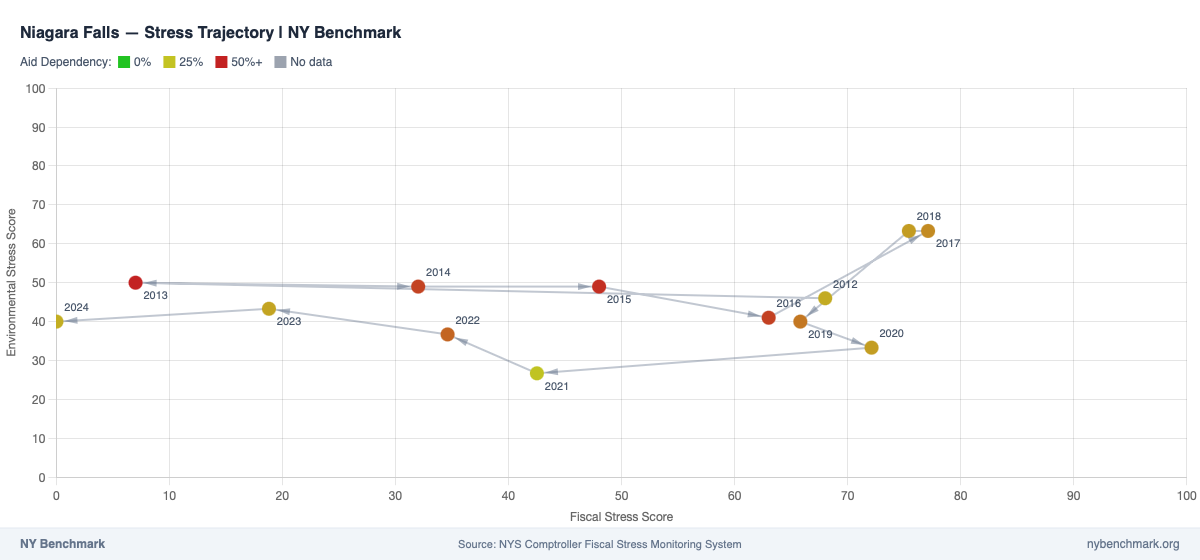
<p><img src="/blog/assets/images/posts/fsms-stress-analysis/niagara-falls-trajectory.png" alt="Niagara Falls stress trajectory showing improvement from ~75 fiscal stress in 2012 to near 0 in 2024" />
<em><a href="https://benchmarkusa.org/entities/niagara_falls">Niagara Falls</a> went from “Significant Fiscal Stress” (score ~75) in 2012 to near zero by 2024 — a textbook turnaround.</em></p>
<h2 id="a-single-year-doesnt-tell-the-story">A single year doesn’t tell the story</h2>

<p>The NYS Comptroller’s <a href="https://www.osc.ny.gov/local-government/fiscal-monitoring">Fiscal Stress Monitoring System</a> (FSMS) scores local governments on two dimensions: fiscal stress (fund balance, cash, operating deficits) and environmental stress (population trends, poverty, property values). Higher scores mean more stress — 0 is healthy, 100 is significant stress.</p>

<p>A scatter chart of the latest year gives you a useful snapshot. You can see which cities are under fiscal pressure and which face environmental headwinds. But one year is just a moment. Is a city at 45 fiscal stress getting better or worse? Did it spike from 20 last year, or slowly decline from 70?</p>

<p>That’s what the trajectory chart answers.</p>

<h2 id="how-to-read-a-trajectory">How to read a trajectory</h2>

<p>Each trajectory chart plots fiscal stress (x-axis) against environmental stress (y-axis) with connected points showing the path a city has taken from 2012 to the present. The dots are color-coded by aid dependency — green means low reliance on state and federal aid, red means high.</p>

<p>Movement toward the bottom-left corner (lower scores on both axes) means improving health. Movement toward the top-right means worsening conditions. The arrowheads on each segment show the direction of change year over year.</p>

<p>Some patterns you’ll see:</p>

<ul>
  <li><strong>Steady improvement</strong>: a clear path from upper-right toward lower-left, year after year</li>
  <li><strong>Volatile swings</strong>: large jumps in one year followed by corrections</li>
  <li><strong>Environmental lock-in</strong>: fiscal scores improving while environmental scores stay stubbornly high (a city can fix its budget but can’t easily reverse population decline)</li>
  <li><strong>Filing gaps</strong>: missing years appear as breaks in the trajectory, common for cities that filed late or skipped a year</li>
</ul>

<h2 id="what-were-seeing">What we’re seeing</h2>

<p>A few patterns stand out across the dataset:</p>

<p><strong>Environmental stress is stickier than fiscal stress.</strong> Many cities have meaningfully improved their fiscal scores over the past decade — better fund balances, healthier cash positions. But environmental scores (driven by demographics, poverty rates, property values) move slowly. A city can right-size its budget in a year or two; reversing population loss takes a generation.</p>

<p><strong>Aid dependency correlates with trajectory direction.</strong> Cities with high aid dependency (red dots) tend to cluster in the upper-right quadrant and show less improvement over time. Cities that generate more of their own revenue (green dots) have more fiscal flexibility to course-correct.</p>

<p><strong>Niagara Falls: a turnaround story.</strong> As shown in the trajectory above, Niagara Falls had a fiscal stress score near 75 in 2012 — deep in “Significant Fiscal Stress” territory. Over the next decade, the city steadily improved its fiscal position, reaching a score near 0 by 2024. The trajectory tells the story clearly: a long, consistent march from the right side of the chart to the left.</p>

<p><strong>The 2017 methodology change is visible.</strong> FSMS switched from a weighted fraction system (0-1.0) to a direct 100-point scale in 2017. We normalize pre-2017 scores to the 0-100 scale for visual continuity, but you may notice a cluster of trajectory shifts around 2016-2017 that reflect the scoring change rather than actual fiscal movement.</p>

<h2 id="try-it-yourself">Try it yourself</h2>

<p>Explore the full dataset — cities, school districts, counties, towns, and villages — on the <a href="https://benchmarkusa.org/stress-analysis">stress analysis page</a>. Click any dot to see its trajectory, zoom and pan to focus on specific time periods, download charts as PNGs, and expand the data table and indicator breakdown to see exactly which stress indicators drove each year’s score.</p>

<h2 id="data-sources">Data sources</h2>

<p>All scores come from the OSC FSMS, covering fiscal years 2012-2024 for municipalities and 2013-2025 for school districts. Aid dependency is calculated from OSC Annual Financial Report data (state aid + federal aid as a percentage of total operating revenue). See our <a href="https://benchmarkusa.org/methodology">methodology page</a> for details on data processing, normalization, and known limitations.</p>]]></content><author><name>Ben Unger</name></author><category term="features" /><category term="data-analysis" /><category term="fsms" /><category term="fiscal-stress" /><category term="trajectory" /><category term="osc" /><category term="data-visualization" /><category term="stress-trajectory" /><summary type="html"><![CDATA[A new trajectory chart shows how each city's fiscal and environmental stress scores have changed since 2012. Some cities are improving. Others are getting worse. Here's how to read the data.]]></summary><media:thumbnail xmlns:media="http://search.yahoo.com/mrss/" url="https://benchmarkusa.org/blog/assets/images/og-default.png" /><media:content medium="image" url="https://benchmarkusa.org/blog/assets/images/og-default.png" xmlns:media="http://search.yahoo.com/mrss/" /></entry><entry><title type="html">NYC Financial Data: Why the Largest City Needs Its Own Import Pipeline</title><link href="https://benchmarkusa.org/blog/nyc-financial-data/" rel="alternate" type="text/html" title="NYC Financial Data: Why the Largest City Needs Its Own Import Pipeline" /><published>2026-02-19T00:00:00+00:00</published><updated>2026-02-19T00:00:00+00:00</updated><id>https://benchmarkusa.org/blog/nyc-financial-data</id><content type="html" xml:base="https://benchmarkusa.org/blog/nyc-financial-data/"><![CDATA[<p><em>NYC is now live on <a href="https://benchmarkusa.org/entities/nyc">NY Benchmark</a>. Here’s the story of why it wasn’t there before, what we imported, and what surprised us.</em></p>

<h2 id="the-missing-40">The missing 40%</h2>

<p>New York City is home to 8.3 million people — roughly 40% of New York State’s population. It runs the largest municipal government in the country, with a $117 billion budget that dwarfs every other city in the state combined.</p>

<p>And until today, it wasn’t in our dataset.</p>

<p>The reason is structural: NYC has its own <a href="https://comptroller.nyc.gov/">Comptroller</a> and does not file Annual Financial Reports with the NYS Office of the State Comptroller (OSC). Every other city in the state — all 61 of them — files with OSC. NYC operates under an entirely separate reporting system.</p>

<p>This isn’t a data gap we could fix by asking nicely. It required building a separate import pipeline from scratch.</p>

<h2 id="why-acfr-not-budget-data">Why ACFR, not budget data</h2>

<p>NYC publishes financial data through multiple channels: the <a href="https://www.checkbooknyc.com">Checkbook NYC</a> transparency portal, the annual budget, and the Annual Comprehensive Financial Report (ACFR). We evaluated all three.</p>

<p><strong>Budget data was tempting</strong> — it’s well-structured and available through an API. But a municipal budget is a plan, not a record. It reflects political priorities and revenue forecasts at the time of adoption. What actually happens over the next twelve months can look very different. Departments overspend or underspend. Revenue comes in above or below projections. Emergency spending appears that nobody budgeted for. Some governments track closely to their budgets; others treat them more like rough guidelines.</p>

<p>For NYC specifically, the gaps are large. Revenue projections can miss by 4-9%, and expenditure estimates can differ by billions. The <a href="https://cbcny.org/">Citizens Budget Commission</a>, the <a href="https://www.ibo.nyc.ny.gov/">Independent Budget Office</a>, and the Comptroller’s own analysis all document this pattern. If you’re comparing cities to each other — which is the entire point of benchmarking — you need to compare what they actually spent and collected, not what they hoped to.</p>

<p><strong>The ACFR is audited actuals.</strong> An independent auditor has verified the numbers. This is the same standard we use for every other city in the state (via OSC filings), and it’s the standard that credit rating agencies, the Government Finance Officers Association, and academic researchers rely on. Since FY 2022, the NYC Comptroller has published downloadable Excel files containing the ACFR’s statistical tables. The Ten Year Trend tables give us FY 2016-2025 from a single download.</p>

<p>Maintaining audited-actuals-only across all 62 cities is worth the extra work. Mixing budget data for one city with ACFR data for the rest would undermine every comparison on the site.</p>

<h2 id="what-we-imported">What we imported</h2>

<p>From the FY 2025 ACFR statistical tables:</p>

<ul>
  <li><strong>Expenditures</strong> by functional category (General Government, Public Safety, Education, etc.) and by agency (~90 agencies including Police, Fire, DOE, CUNY, Sanitation, and more)</li>
  <li><strong>Revenue</strong> by source (real estate tax, income tax, sales tax, federal grants, state grants, charges for services, etc.)</li>
  <li><strong>Fund balances</strong> by GASB 54 classification (Restricted, Committed, Assigned, Unassigned) for General Fund and all governmental funds</li>
</ul>

<p>In total: <strong>77 metrics, 10 fiscal years (FY 2016-2025), 763 observations</strong>.</p>

<p>We mapped NYC’s functional categories to OSC’s <code class="language-plaintext highlighter-rouge">level_1_category</code> names (e.g., NYC’s “Public Safety and Judicial” becomes “Public Safety”) so that cross-city comparisons work. Agency-level detail goes into <code class="language-plaintext highlighter-rouge">level_2_category</code>, giving NYC richer drill-down data than most other cities have.</p>

<p>One important caveat: the Department of Education’s $34.1 billion appears as a city expenditure line item under “Education.” But unlike upstate cities where school districts are separate entities with their own per-pupil metrics, NYC’s DOE is part of the city government. We capture the spending total but don’t yet break it down as a school district with enrollment-normalized metrics. That’s a future project — and a significant one, given that NYC’s education budget alone is larger than the total budget of most US states.</p>

<h2 id="the-98-agencies-we-havent-mapped-yet">The 98 agencies we haven’t mapped yet</h2>

<p>NYC’s ACFR lists 134 individual agencies across 13 functional categories. We mapped 36 of them to individual <code class="language-plaintext highlighter-rouge">level_2_category</code> entries — the major departments like Police, Fire, DOE, Sanitation, and so on. The remaining 98 are captured in their category totals (no spending is lost at the aggregate level) but aren’t broken out individually yet.</p>

<p>Some of these unmapped agencies are uniquely NYC:</p>

<table>
  <thead>
    <tr>
      <th>Group</th>
      <th>Count</th>
      <th>FY 2025 Total</th>
      <th>Notes</th>
    </tr>
  </thead>
  <tbody>
    <tr>
      <td>District Attorneys</td>
      <td>5</td>
      <td>$510.6M</td>
      <td>One per borough — other cities have DAs at the county level</td>
    </tr>
    <tr>
      <td>Borough Presidents</td>
      <td>5</td>
      <td>$32.6M</td>
      <td>No equivalent in any other NY city</td>
    </tr>
    <tr>
      <td>Community Boards</td>
      <td>55</td>
      <td>$17.7M</td>
      <td>~$300K each, hyper-local advisory bodies</td>
    </tr>
    <tr>
      <td>Campaign Finance Board</td>
      <td>1</td>
      <td>$144.9M</td>
      <td>NYC’s public matching funds program</td>
    </tr>
    <tr>
      <td>Board of Elections</td>
      <td>1</td>
      <td>$273.4M</td>
      <td>Most cities handle this at county level</td>
    </tr>
  </tbody>
</table>

<p>These aren’t data gaps — they’re structural differences in how NYC governs compared to every other city in the state. Borough Presidents, Community Boards, and a citywide DA system with five offices don’t exist anywhere else. Mapping them to OSC-compatible categories requires careful judgment about where they fit, and in some cases they simply don’t have a clean equivalent.</p>

<h2 id="parsing-the-excel-files">Parsing the Excel files</h2>

<p>The technical challenge wasn’t the data itself — it was extracting it from Excel files that were clearly designed for human reading, not machine processing.</p>

<p>The ACFR statistical tables are formatted for print. Agency names spill across multiple rows because they’re too long for a single cell. Category headers like “General Government:” sit on their own row with no numeric data. Some categories span multiple pages and repeat with “(cont.)” appended. The fund balance file has decorative filler text between section headers.</p>

<p>A few specific headaches:</p>

<p><strong>Multi-row agency names.</strong> “260 Department of Youth and Community Development” spans three rows in the spreadsheet — the name on the first two rows (text only, no numbers), the data on the third. The importer accumulates text-only rows and prepends them when it hits a data row.</p>

<p><strong>Category headers vs. name fragments.</strong> Both are text-only rows with no numbers. The difference: category headers end with a colon. But some category names <em>also</em> span two rows (“Parks, Recreation, and / Cultural Activities:”), so the importer has to distinguish between a legitimate two-row header and filler text that accumulated before the real header.</p>

<p><strong>Filler text accumulation.</strong> The fund balance file has rows like “Capital projects,” “Debt service,” “Noncurrent mortgage loans” sitting between “Reserved for:” and “Committed for:” — descriptive labels with no data. If the importer naively combines all accumulated text with the next colon-terminated header, you get nonsense. The fix: only combine if exactly one text row was accumulated (a legitimate two-row header). Three or more accumulated rows get discarded as filler.</p>

<p>We verified the parser’s output against exact dollar amounts from the published ACFR PDF. Police Department: $6,610,389,000. Total Expenditures: $109,610,157,000. Real Estate Tax: $34,756,900,000. Every number matches to the dollar.</p>

<h2 id="the-fund-balance-surprise">The fund balance surprise</h2>

<p>This was the most interesting finding. When you look up a typical NY city’s fiscal health, one of the key metrics is <strong>Fund Balance %</strong> — Unassigned General Fund Balance (account code A917) as a percentage of expenditures. This tells you how many months of reserves a city has.</p>

<p>NYC’s General Fund has <strong>no unassigned fund balance</strong>. Zero.</p>

<p>This doesn’t mean NYC is broke. It means NYC classifies its reserves differently:</p>

<ul>
  <li><strong>Restricted:</strong> $2.0 billion (legally restricted for specific purposes)</li>
  <li><strong>Committed:</strong> $1.97 billion (the Revenue Stabilization Fund — NYC’s rainy day fund, committed by City Council resolution)</li>
</ul>

<p>Under GASB 54, “Committed” is one step below “Assigned” and two steps below “Unassigned.” NYC’s policy is to park its reserves in the Committed classification, which has a higher bar for release (requires City Council action). This is arguably <em>more</em> fiscally conservative than leaving reserves as “Unassigned.”</p>

<p>We’ve updated our Fund Balance % metric to use <strong>Available Fund Balance</strong> — the sum of Committed, Assigned, and Unassigned balances. This is what credit rating agencies (Moody’s, S&amp;P) and the <a href="https://www.gfoa.org/">GFOA</a> actually look at. Under this definition, NYC’s $1.97B Committed balance shows up correctly. The old metric (Unassigned only) would have shown 0% — a classification artifact, not a sign of financial weakness. Buffalo had the same problem in some years after moving reserves to their Committed rainy day fund.</p>

<p>We’ve also added domain notes in our <a href="/blog/mcp/">MCP server</a> to flag NYC’s unique fund balance structure for AI tools that query the data.</p>

<h2 id="key-numbers-fy-2025">Key numbers (FY 2025)</h2>

<table>
  <thead>
    <tr>
      <th>Metric</th>
      <th>Value</th>
    </tr>
  </thead>
  <tbody>
    <tr>
      <td>Total Expenditures</td>
      <td>$109.6 billion</td>
    </tr>
    <tr>
      <td>Total Revenue</td>
      <td>$117.7 billion</td>
    </tr>
    <tr>
      <td>Police Department</td>
      <td>$6.6 billion</td>
    </tr>
    <tr>
      <td>Fire Department</td>
      <td>$2.5 billion</td>
    </tr>
    <tr>
      <td>Department of Education</td>
      <td>$34.1 billion</td>
    </tr>
    <tr>
      <td>Real Estate Tax</td>
      <td>$34.8 billion</td>
    </tr>
    <tr>
      <td>Committed Fund Balance (GF)</td>
      <td>$2.0 billion</td>
    </tr>
  </tbody>
</table>

<p>For context, NYC’s police budget alone ($6.6B) is larger than the entire budget of any other city in the state. Per-capita and percentage metrics are the only meaningful way to compare NYC with its peers.</p>

<h2 id="whats-next">What’s next</h2>

<ul>
  <li><strong>MCP server</strong> — Our <a href="/blog/mcp/">MCP server</a> lets AI tools like Claude query NYC and all other city data directly, with domain-aware caveats that flag comparability issues like fund balance classification automatically.</li>
  <li><strong>Agency-level drill-downs</strong> — The remaining 98 agencies, including District Attorneys, Borough Presidents, and Community Boards, will get individual mappings in a future update.</li>
  <li><strong>Historical extension</strong> — The FY 2022 ACFR ZIP extends some metrics back to FY 2005. A future import will add that historical depth.</li>
  <li><strong>DOE as a school district</strong> — Breaking out the Department of Education’s $34.1B with per-pupil and enrollment-normalized metrics, comparable to our upstate school district data.</li>
</ul>

<p>NYC is live now at <a href="https://benchmarkusa.org/entities/nyc">benchmarkusa.org/entities/nyc</a>.</p>

<div class="page-cta-banner">
  <a href="https://benchmarkusa.org" class="page-cta-link">Explore the data at benchmarkusa.org &rarr;</a>
</div>]]></content><author><name>Ben Unger</name></author><category term="data-sources" /><category term="data-quality" /><category term="nyc" /><category term="acfr" /><category term="osc" /><category term="fund-balance" /><category term="gasb-54" /><category term="excel-parsing" /><category term="data-pipeline" /><summary type="html"><![CDATA[NYC is 40% of New York State but was missing from our dataset. We built a custom ACFR import — 77 metrics, 10 years, 763 observations of audited actuals. Here's what we found.]]></summary><media:thumbnail xmlns:media="http://search.yahoo.com/mrss/" url="https://benchmarkusa.org/blog/assets/images/og-default.png" /><media:content medium="image" url="https://benchmarkusa.org/blog/assets/images/og-default.png" xmlns:media="http://search.yahoo.com/mrss/" /></entry><entry><title type="html">145 Million Americans Live in States With Transparent Local Government Finances</title><link href="https://benchmarkusa.org/blog/2026/02/02/state-local-government-financial-data.html" rel="alternate" type="text/html" title="145 Million Americans Live in States With Transparent Local Government Finances" /><published>2026-02-02T00:00:00+00:00</published><updated>2026-02-03T00:00:00+00:00</updated><id>https://benchmarkusa.org/blog/2026/02/02/state-local-government-financial-data</id><content type="html" xml:base="https://benchmarkusa.org/blog/2026/02/02/state-local-government-financial-data.html"><![CDATA[<p><em>A fifty-state review of how local government financial data is collected, structured, and published</em></p>

<figure style="margin: 2rem 0; text-align: center;">
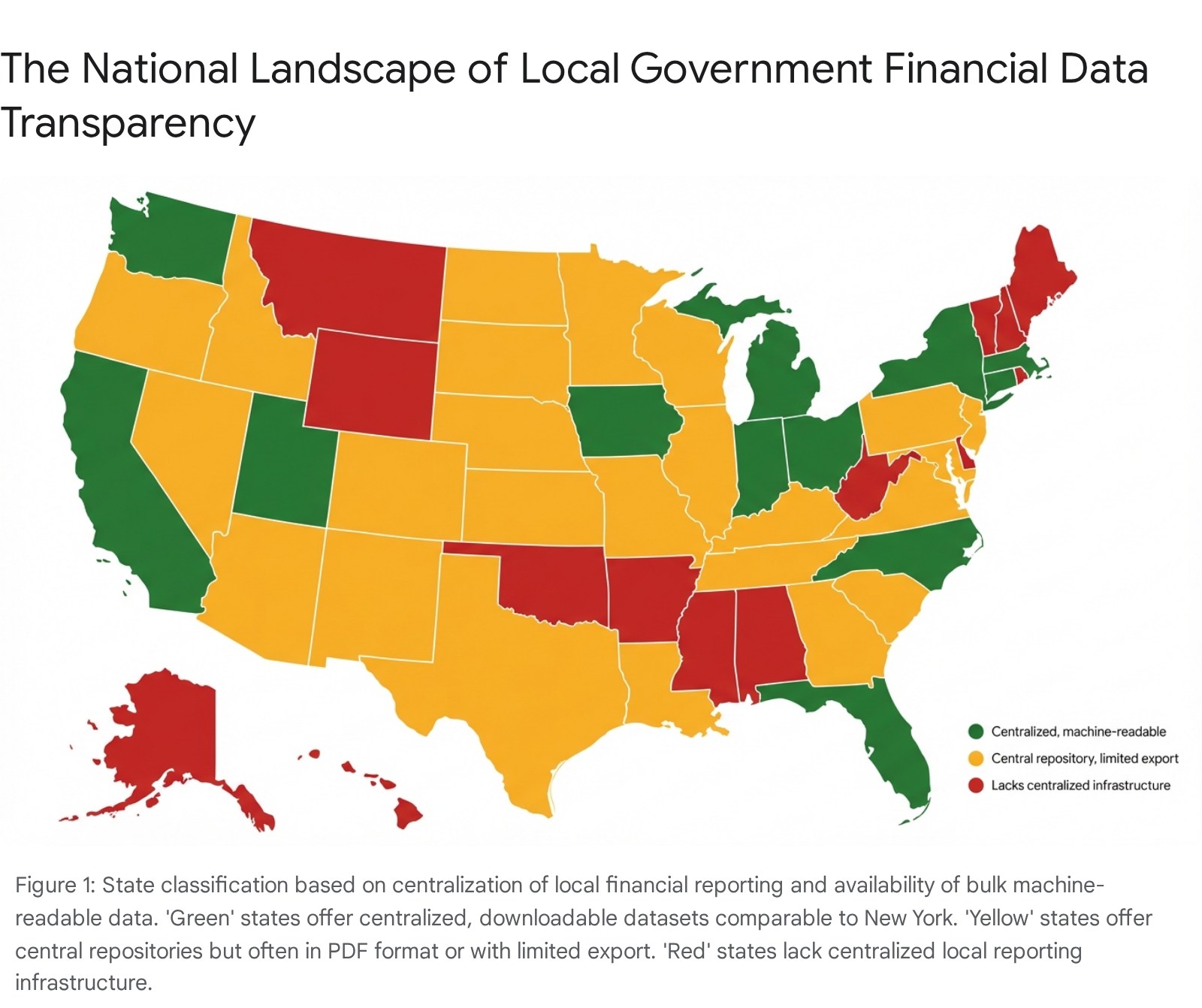
  <img src="/blog/assets/images/posts/state-local-government-financial-data/state-data-availability-map.png" alt="U.S. map color-coded by state financial data transparency: Green (12 states), Yellow (varying), Red (minimal)." />
  <figcaption style="font-size: 0.85rem; color: #666; margin-top: 0.8rem; line-height: 1.4;">
    <strong>Source:</strong> Analysis synthesized and map generated by <strong>Google Gemini (Deep Research)</strong>, January 2026. 
    <br />
    <em>Note: Rankings based on automated review of state-level reporting requirements and machine-readable data availability.</em>
  </figcaption>
</figure>

<p>I started this project in New York because I live here.  Later, I wanted to know: how many other states have the same kind of data?</p>

<p>When I started seven weeks ago, my plan was to manually download PDF audit reports from every city, county, town, village, district, and authority in the state, then either hand-enter the financial data myself or secure funding to have credible freelancers help me.  I spent the first several weeks doing exactly that — pulling ACFRs for cities like Yonkers and New Rochelle and seeding my database by hand.</p>

<p>Then I got lucky.  I discovered that New York’s Office of the State Comptroller had already collected all of this data and made it available for bulk download in machine-readable form.  Weeks of planned manual labor replaced by a few import scripts.  That lucky break raised an obvious follow-up question: which other states have done the same thing?</p>

<h2 id="the-fifty-state-review">The Fifty-State Review</h2>

<p>I conducted a review of all fifty states to understand how each one collects, standardizes, and publishes local government financial information.  I used Google Gemini’s Deep Research to systematically review state comptroller sites, statutory reporting requirements, and public data portals.  The tooling dramatically accelerated discovery, but the classifications, interpretations, and conclusions are my own.</p>

<p>What I found is a sharp structural divide in how different states consider, collect and make available local government financial data.</p>

<h2 id="the-real-transparency-divide">The Real Transparency Divide</h2>

<p>The key distinction is not whether data is “public” — virtually all government financial data is technically public.  The question is whether it’s <strong>structured</strong>.</p>

<p>In states like New York, Washington, Ohio, Indiana, and the other green states on the map above, local governments submit standardized financial data into centralized systems.  These platforms enforce uniform charts of accounts, validation rules, and consistent definitions.  Spending, debt, and fiscal health can be compared across jurisdictions with minimal manual work.</p>

<p>Unfortunately, in much of the country, financial disclosure still means posting standalone audit PDFs.  Try comparing per-capita police spending across 200 municipalities when each one publishes a different 300-page PDF with its own chart of accounts.  It’s functionally opaque.</p>

<p>And then there are the states that have no centralized local reporting infrastructure at all.</p>

<p>The green states have centralized, machine-readable systems.  Yellow states have central repositories but the data is often PDF-only or limited in export options.  Red states lack centralized local reporting infrastructure entirely.</p>

<h2 id="145-million-americans-can-see-how-their-tax-dollars-are-spent">145 Million Americans Can See How Their Tax Dollars Are Spent</h2>

<p>The good news is that those twelve green states are home to over 145 million people — <strong>nearly 44% of the country</strong> according to the 2020 Census.  That’s how many Americans currently live in states where structured local government financial data exists and bulk comparative analysis is possible.  The other 56% are largely in the dark.</p>

<p>Those local governments collectively spent approximately <strong>$1.18 trillion</strong> in FY 2022, according to the U.S. Census Bureau’s <a href="https://www.census.gov/programs-surveys/gov-finances.html">Annual Survey of State and Local Government Finances</a> — a massive share of public spending that, in these twelve states, can actually be tracked and compared.</p>

<h2 id="the-best-state-databases">The Best State Databases</h2>

<p>see below for more links and details about the best state local government financial dtabases.  I’ve ordered them roughly by how useful they are for the kind of bulk comparative analysis I’m doing:</p>

<table>
  <thead>
    <tr>
      <th>State</th>
      <th>Database</th>
      <th>Notes</th>
    </tr>
  </thead>
  <tbody>
    <tr>
      <td>Florida</td>
      <td><a href="https://logerx.myfloridacfo.gov/">LOGERx</a></td>
      <td>First-in-the-nation XBRL mandate; the gold standard</td>
    </tr>
    <tr>
      <td>New York</td>
      <td><a href="https://www.osc.ny.gov/local-government/data">Open Book NY / FSMS</a></td>
      <td>Uniform chart of accounts; bulk CSV for all local governments</td>
    </tr>
    <tr>
      <td>Utah</td>
      <td><a href="https://transparent.utah.gov/">Transparent Utah</a></td>
      <td>~1,000 entities; 250M+ records; all local governments required to submit since 2017</td>
    </tr>
    <tr>
      <td>Washington</td>
      <td><a href="https://portal.sao.wa.gov/FIT/">Financial Intelligence Tool</a></td>
      <td>~2,000 governments; decade of data; peer comparison and fiscal health indicators</td>
    </tr>
    <tr>
      <td>Ohio</td>
      <td><a href="https://checkbook.ohio.gov/">Ohio Checkbook</a></td>
      <td>Transaction-level detail down to individual checks; voluntary for local governments</td>
    </tr>
    <tr>
      <td>Indiana</td>
      <td><a href="https://gateway.ifionline.org/">Gateway</a></td>
      <td>All local units; downloadable data; extensive report builder</td>
    </tr>
    <tr>
      <td>Michigan</td>
      <td><a href="https://micommunityfinancials.michigan.gov/">Community Financial Dashboard</a></td>
      <td>12+ fiscal health indicators; 16 years of data; developing its own XBRL taxonomy</td>
    </tr>
    <tr>
      <td>California</td>
      <td><a href="https://bythenumbers.sco.ca.gov/">ByTheNumbers</a></td>
      <td>State Controller; 13M+ fields; cities, counties, special districts; data back to 2002</td>
    </tr>
    <tr>
      <td>North Carolina</td>
      <td><a href="https://www.nctreasurer.gov/divisions/state-and-local-government-finance/lgc/data-and-reports">LGC Data &amp; Reports</a></td>
      <td>Legislatively mandated since 2015; counties and municipalities; benchmarking tool</td>
    </tr>
    <tr>
      <td>Connecticut</td>
      <td><a href="https://portal.ct.gov/OPM/IGP-MUNFINS/Municipal-Financial-Services/Municipal-Finance-Home-Page">Municipal Fiscal Indicators</a></td>
      <td>All 169 municipalities; structured budget data on <a href="https://data.ct.gov/">data.ct.gov</a></td>
    </tr>
    <tr>
      <td>Massachusetts</td>
      <td><a href="https://www.mass.gov/info-details/municipal-finance-trend-dashboard">Municipal Databank</a></td>
      <td>65+ data elements; community comparison tool with Excel export; no bulk download</td>
    </tr>
    <tr>
      <td>Iowa</td>
      <td><a href="https://data.iowa.gov/">data.iowa.gov</a> / <a href="https://city-budget-explorer.iowa.gov/">City Budget Explorer</a></td>
      <td>Mandatory (Iowa Code Ch. 24); ~1,800 entities; CSV, JSON, and API via Socrata</td>
    </tr>
  </tbody>
</table>

<h2 id="florida-the-gold-standard">Florida: The Gold Standard</h2>

<p>Florida deserves special mention.  In 2018, the state passed HB 1073 mandating that all local governments file their financial reports in <a href="https://en.wikipedia.org/wiki/XBRL">XBRL</a> — the same structured data standard the SEC requires for corporate filings.  The LOGERx system went live in 2022 and remains the first and only state-level XBRL mandate for local government financials in the country.  Most other green states, including New York, publish bulk CSV or offer interactive dashboards, which is excellent for analysis but doesn’t carry the semantic richness of XBRL.  If other states follow Florida’s lead, a truly comprehensive national database of local government finances becomes possible.</p>

<h2 id="california-a-cautionary-tale">California: A Cautionary Tale</h2>

<p>California illustrates both the promise and the fragility of transparency infrastructure.  The state’s raw data is solid — the State Controller’s <a href="https://bythenumbers.sco.ca.gov/">ByTheNumbers</a> portal publishes 13 million+ fields of structured financial data for cities, counties, and special districts going back to 2002.  Up until very recently they had a <a href="https://benchmarkusa.org">NYBenchmark-like</a> analytical layer that made that highlighted at risk governments and made the data more accessible to non-experts.  The State Auditor’s High-Risk Local Government Dashboard ranked all 471 California cities on fiscal health using ten financial indicators — exactly the kind of tool that lets residents and journalists ask hard questions about how their local government is managing money.  Then in October 2023, following a change in leadership at the auditor’s office, the dashboard was <a href="https://californiapolicycenter.org/californias-high-risk-dashboard-is-gone-without-a-trace-but-should-not-be-forgotten/">quietly discontinued and scrubbed from the website</a>.  No announcement, no archive, no explanation.</p>

<p>This shouldn’t surprise anyone.  Structured financial data invites scrutiny, and scrutiny creates pressure.  There will always be elected officials and government employees who resent having their spending decisions compared to their neighbors’.  That resentment is a feature, not a bug — it means the data is doing its job.  But it also means transparency infrastructure is perpetually at risk of being defunded, deprioritized, or quietly shut down by the very people it’s designed to hold accountable.</p>

<p>The problem is compounded by the <a href="https://localnewsinitiative.northwestern.edu/projects/state-of-local-news/">collapse of local news</a> across the country and around the world.  When California killed its dashboard, there was barely anyone left to notice.  The <a href="https://californiapolicycenter.org/dashboard-launch/">California Policy Center</a>, a good-government nonprofit, has since built a replacement — but civic projects come and go, and the underlying data should never depend on one organization’s funding or interest.  The episode illustrates why transparency infrastructure needs to be grounded in statutory mandate — like Florida’s XBRL requirement — rather than left to the discretion of whoever happens to hold office.  Dashboards built on political goodwill can disappear the moment that goodwill changes.</p>

<p>The variation across these systems is significant — in format, granularity, whether participation is mandatory, and how easy they make bulk access.</p>

<h2 id="where-this-goes-next">Where This Goes Next</h2>

<p>There’s no reason this project should stay limited to New York.  Every green state on the map above has the data infrastructure to support the same kind of cross-jurisdictional benchmarking I’m doing now.  Washington, Ohio, Indiana, Michigan — these states are ready for the same treatment, and expanding to cover them is a medium-term goal.</p>

<p>For the yellow and red states, I hope this analysis is useful in a different way.  The gap between “we publish audit PDFs” and “we have a centralized, structured reporting system” is the gap between nominal transparency and functional transparency.  States that close that gap don’t just help researchers and civic tech projects — they give their own residents, journalists, and policymakers the ability to ask basic comparative questions about how their tax dollars are being spent.  Every state should aspire to be green on this map.</p>

<p>The absence of structured data is the main reason civic technology projects so often stall outside a handful of states.  Identifying where high-quality data already exists is the first step toward scalable, cross-jurisdictional accountability.</p>

<p>Live New York benchmarking work based on this analysis is available at <a href="https://benchmarkusa.org">benchmarkusa.org</a>.</p>]]></content><author><name>Ben Unger</name></author><category term="transparency" /><category term="data-quality" /><category term="open-data" /><category term="state-comptroller" /><category term="osc" /><category term="structured-data" /><category term="fifty-state-review" /><category term="benchmarking" /><summary type="html"><![CDATA[A fifty-state review of how local government financial data is collected, structured, and published reveals that 43% of Americans live in states with machine-readable financial data — and the other 57% are largely in the dark.]]></summary><media:thumbnail xmlns:media="http://search.yahoo.com/mrss/" url="https://benchmarkusa.org/blog/assets/images/posts/state-local-government-financial-data/state-data-availability-map.png" /><media:content medium="image" url="https://benchmarkusa.org/blog/assets/images/posts/state-local-government-financial-data/state-data-availability-map.png" xmlns:media="http://search.yahoo.com/mrss/" /></entry><entry><title type="html">NY Local Governments Not Filing Annual Financial Reports – The Dogs That Don’t Bark</title><link href="https://benchmarkusa.org/blog/2026/01/31/annual-financial-report-non-filers.html" rel="alternate" type="text/html" title="NY Local Governments Not Filing Annual Financial Reports – The Dogs That Don’t Bark" /><published>2026-01-31T00:00:00+00:00</published><updated>2026-01-31T00:00:00+00:00</updated><id>https://benchmarkusa.org/blog/2026/01/31/annual-financial-report-non-filers</id><content type="html" xml:base="https://benchmarkusa.org/blog/2026/01/31/annual-financial-report-non-filers.html"><![CDATA[<p>Being the <a href="https://www.merriam-webster.com/dictionary/completist">completist</a> that I am, it didn’t take me long to see the gaps in my data.  What’s up with that?  Turns out that some local governments and school districts don’t get their financial information into the New York Office of the State Comptroller (OSC).  Turns out that there are some completists at the OSC, too.  They don’t just publish details about <a href="https://www.osc.ny.gov/files/local-government/fiscal-monitoring/2024/pdf/2024-munis-stressed.pdf">local governments</a> and <a href="https://www.osc.ny.gov/files/local-government/fiscal-monitoring/pdf/2025-schools-stressed.pdf">school districts</a> in fiscal stress.  They also do a great job of publicizing those entities, <a href="https://www.osc.ny.gov/files/local-government/fiscal-monitoring/2024/pdf/2024-munis-not-filed.pdf">local governments</a> and <a href="https://www.osc.ny.gov/files/local-government/fiscal-monitoring/pdf/2025-schools-not-filed.pdf">school districts</a>, that don’t manage to get their paperwork in at all – the non-filers.</p>

<h2 id="why-it-matters">Why It Matters</h2>

<p>My hope is that this project will highlight the practices of communities that are particularly well run, delivering world class government services at a reasonable price, but also draw attention to those governments that are particularly mismanaged.  I’ve got faith that voters want good government and are willing to vote for politicians who manage and hire in such a way that delivers it.  I also believe that voters often have a hard time knowing exactly what is going on in their governments.  When governments and school districts fail to get their paperwork into the OSC, you have to wonder if they know themselves what is going on inside.  For more on how we use OSC data and what we measure, see our <a href="/blog/methods/">methodology</a>.</p>

<h2 id="chronic-vs-occasional-non-filers">Chronic vs. Occasional Non-Filers</h2>

<p>In any given year, there are governments and school districts with otherwise ok finances that miss a year.  We can imagine a retirement or maternity leave leaving a community with the temporary loss of capacity to get that paperwork in.  Those communities will recover and do fine.  It’s the chronic non-filers that we’ve got to worry about.</p>

<h2 id="what-the-data-shows">What the Data Shows</h2>

<p>The NY Benchmarking Project Database highlights the <a href="https://benchmarkusa.org/non-filers">cities that haven’t gotten their OSC Annual Financial Report paperwork into the OSC</a> and differentiates those that just miss a year here and there from those few that are chronic non-filers.  Currently, just three cities are chronic non-filers: <a href="https://benchmarkusa.org/entities/mount_vernon">Mount Vernon</a>, <a href="https://benchmarkusa.org/entities/ithaca">Ithaca</a>, and <a href="https://benchmarkusa.org/entities/rensselaer">Rensselaer</a>.</p>

<h2 id="whats-next">What’s Next</h2>

<p>As we add more data – the counties, towns, villages, districts, and authorities – we’ll highlight the well run as well as those in stress and not filing, too.</p>]]></content><author><name>Ben Unger</name></author><category term="transparency" /><category term="data-quality" /><category term="non-filers" /><category term="annual-financial-reports" /><category term="osc" /><category term="fiscal-stress" /><category term="mount-vernon" /><category term="ithaca" /><category term="rensselaer" /><summary type="html"><![CDATA[Several New York State cities chronically fail to file Annual Financial Reports with the State Comptroller, leaving taxpayers in the dark about their government's finances.]]></summary><media:thumbnail xmlns:media="http://search.yahoo.com/mrss/" url="https://benchmarkusa.org/blog/assets/images/og-default.png" /><media:content medium="image" url="https://benchmarkusa.org/blog/assets/images/og-default.png" xmlns:media="http://search.yahoo.com/mrss/" /></entry><entry><title type="html">Audit Time: Pausing to Verify Municipal Financial Data Accuracy</title><link href="https://benchmarkusa.org/blog/2026/01/29/audit-time.html" rel="alternate" type="text/html" title="Audit Time: Pausing to Verify Municipal Financial Data Accuracy" /><published>2026-01-29T00:00:00+00:00</published><updated>2026-01-29T00:00:00+00:00</updated><id>https://benchmarkusa.org/blog/2026/01/29/audit-time</id><content type="html" xml:base="https://benchmarkusa.org/blog/2026/01/29/audit-time.html"><![CDATA[<p>I pushed my first line of code to <a href="https://github.com">GitHub</a> on December 13, 2025, about 6 weeks ago, and have been wrestling with getting this database set up to accurately compare the financial data of the hundreds of political entities in the great state of New York.  I spent soul killing hours over many days poring over the most recent <a href="https://en.wikipedia.org/wiki/Annual_comprehensive_financial_report">Annual Comprehensive Financial Report</a>, often called an “ACFR,” for my city and <a href="https://en.wikipedia.org/wiki/New_Rochelle,_New_York">New Rochelle</a>.  At around 81 thousand people, New Rochelle is New York’s 7th largest city and the largest one with a <a href="https://en.wikipedia.org/wiki/Council%E2%80%93manager_government">council-manager</a> organization.</p>

<p>But governmental finance is complex, often influenced by the exigencies – political, financial, etc. – of the moment rather than by any interest in clarity and standardization.  New Rochelle, for instance, has a school system that is politically (elected school board) and financially (levies its own taxes) independent.  My city, in contrast, has a strong mayor who appoints the school board and the city pays for all of the school district’s expenses.  I need to subtract out education-related expenses if I want to compare my city with New Rochelle.</p>

<h2 id="custodial-pass-throughs">Custodial Pass-Throughs</h2>

<p>But it doesn’t stop there.  My initial data showed that White Plains was “spending” more per capita than any other city in NY – over $8k, almost double the next city.  I looked more closely and noticed that White Plains and several other cities in Westchester and Nassau counties collect taxes on behalf of the county, school districts, and special districts, then pass those dollars along.  That’s not spending but I was counting it as such.  Once I pulled those custodial pass-throughs out, White Plains’ per-capita spending dropped to a more reasonable level, ranking it #4 instead of #1.</p>

<h2 id="interfund-transfers">Interfund Transfers</h2>

<p>I also found a second problem: interfund transfers.  The data I’m working with comes from the <a href="https://www.osc.ny.gov/">Office of the New York State Comptroller</a> (OSC), which reports finances at the fund level, not the consolidated government-wide level that cities publish in their ACFRs.  When a city moves money from its General Fund to its Debt Service Fund, that shows up as an “expenditure” in one fund and “revenue” in another.  Sum across all funds without eliminating these internal transfers and you double-count.  Across all cities and years in the database, that’s $10.5 billion in phantom spending.</p>

<h2 id="the-plattsburgh-anomaly">The Plattsburgh Anomaly</h2>

<p>A particularly weird manifestation of this: I highlight the percent of total annual spending that a community spends on debt service, which seems like a good metric for how well a community has been living within its means.  Plattsburgh, NY was showing debt service at 156% of annual spending – a mathematical impossibility.  The problem was that my code was only counting General Fund expenditures in the denominator while including debt service from all funds in the numerator.  Plattsburgh books all of its debt in non-General Fund accounts, so the denominator was artificially small.  Once I included all funds (minus the custodial pass-throughs and interfund transfers), the number dropped to a still-high-but-real 38.7%.</p>

<h2 id="time-for-an-audit">Time for an Audit</h2>

<p>I’m glad I was able to find and fix these outliers but it raises the question: what other errors are lurking in my data?  I don’t want to be like the <a href="https://en.wikipedia.org/wiki/Beardstown_Ladies">Beardstown Ladies Investment Club</a> who claimed in <a href="https://www.amazon.com/Beardstown-Ladies-Common-Sense-Investment-Guide/dp/0786881208">their 1995 bestseller on investment advice</a> that they earned a 23.4% annual return since inception.  Three books later an audit showed their actual return was 9.1%, well below the S&amp;P 500 returns for the time period.  Time for an internal audit to see if my numbers match what the cities report in their own ACFRs rather than my interpretation of what the OSC is collecting and publishing on the cities’ behalf.  See details of what I’ll be looking for in the <a href="https://github.com/BenU/nybenchmark-app/blob/main/AUDIT.md">app’s AUDIT.md file</a>.</p>

<p>I’ll update what I find here.  Fingers crossed that my numbers aren’t too far off – and if they are, better to find out now than after someone makes a decision based on bad data.</p>]]></content><author><name>Ben Unger</name></author><category term="data-quality" /><category term="audit" /><category term="acfr" /><category term="osc" /><category term="custodial-pass-throughs" /><category term="interfund-transfers" /><category term="white-plains" /><category term="plattsburgh" /><category term="new-rochelle" /><summary type="html"><![CDATA[Municipal financial data from the NYS Comptroller is complex and inconsistent. We're auditing our numbers against city ACFRs to ensure accuracy before anyone relies on them.]]></summary><media:thumbnail xmlns:media="http://search.yahoo.com/mrss/" url="https://benchmarkusa.org/blog/assets/images/og-default.png" /><media:content medium="image" url="https://benchmarkusa.org/blog/assets/images/og-default.png" xmlns:media="http://search.yahoo.com/mrss/" /></entry><entry><title type="html">Same New York, But Better</title><link href="https://benchmarkusa.org/blog/2025/12/12/same-new-york-but-better.html" rel="alternate" type="text/html" title="Same New York, But Better" /><published>2025-12-12T00:00:00+00:00</published><updated>2025-12-12T00:00:00+00:00</updated><id>https://benchmarkusa.org/blog/2025/12/12/same-new-york-but-better</id><content type="html" xml:base="https://benchmarkusa.org/blog/2025/12/12/same-new-york-but-better.html"><![CDATA[<p>New York is a place of extraordinary ambition, talent, and cultural vitality.
It attracts people from around the world and inspires deep loyalty from those who call it home. Yet when it comes to the everyday functioning of government— at all levels —New York too often tolerates outcomes that fall well short of what its residents should reasonably expect.</p>

<p>This project starts from a simple contention:</p>

<blockquote>
  <p><strong>Government at the local, county, and state level can be more effective, more efficient, and more affordable if it is more transparent and if we systematically compare outcomes across jurisdictions.</strong></p>
</blockquote>

<p>The New York Benchmarking Project exists to make that comparison possible.</p>

<hr />

<h2 id="why-benchmarking">Why Benchmarking?</h2>

<p>Benchmarking is the practice of comparing organizations performing similar functions in order to identify best practices, outliers, and inefficiencies. It is routine in private industry, medicine, logistics, and engineering. It is far less routine in local government, where fragmentation, nonstandard reporting, and political incentives often obscure comparison.</p>

<p>Yet New York and states around the country contain a natural laboratory.  Here we’ve got:</p>

<ul>
  <li>62 cities, ranging from very small to very large</li>
  <li>62 counties (a numerical coincidence, not a structural symmetry)</li>
  <li>Hundreds of towns, villages, and special districts</li>
  <li>Largely shared legal frameworks</li>
  <li>Common state oversight and reporting requirements</li>
</ul>

<p>If one city delivers public services at lower cost with equal or better outcomes, that fact should be visible.
If another city spends far more for worse results, that too should be visible.</p>

<p>Benchmarking does not dictate policy. It <strong>creates the conditions for informed judgment</strong>.</p>

<hr />

<h2 id="the-problem-transparency-but-fragmentation">The Problem: Transparency but Fragmentation</h2>

<p>New York and our <a href="https://www.osc.ny.gov">Office of the State Comptroller</a> is actually a national leader in <a href="https://www.osc.ny.gov/local-government/data">collecting and disseminating municipal financial data</a>:  Much of the data is available but it’s not standardized or designed to compare one jurisdiction with another.  The OSC also doesn’t provide demographic information like population, education, median home values and crime rates.  Those details come from other databases like the US Census office and the Department of Justice.</p>

<p>As a result, even engaged citizens, journalists, and policymakers struggle to answer basic questions such as:</p>

<ul>
  <li>How much does this city spend per resident on core services?</li>
  <li>How do employee compensation and benefits compare to peer cities?</li>
  <li>Are debt levels and long-term liabilities out of line with similar communities?</li>
</ul>

<hr />

<h2 id="voice-exit-and-decline">Voice, Exit, and Decline</h2>

<p>When local governance performs poorly, residents have three broad responses: <a href="https://en.wikipedia.org/wiki/Exit,_Voice,_and_Loyalty"><strong>Exit, Voice, and Loyalty</strong></a>.</p>

<p>New York has increasingly seen the former.</p>

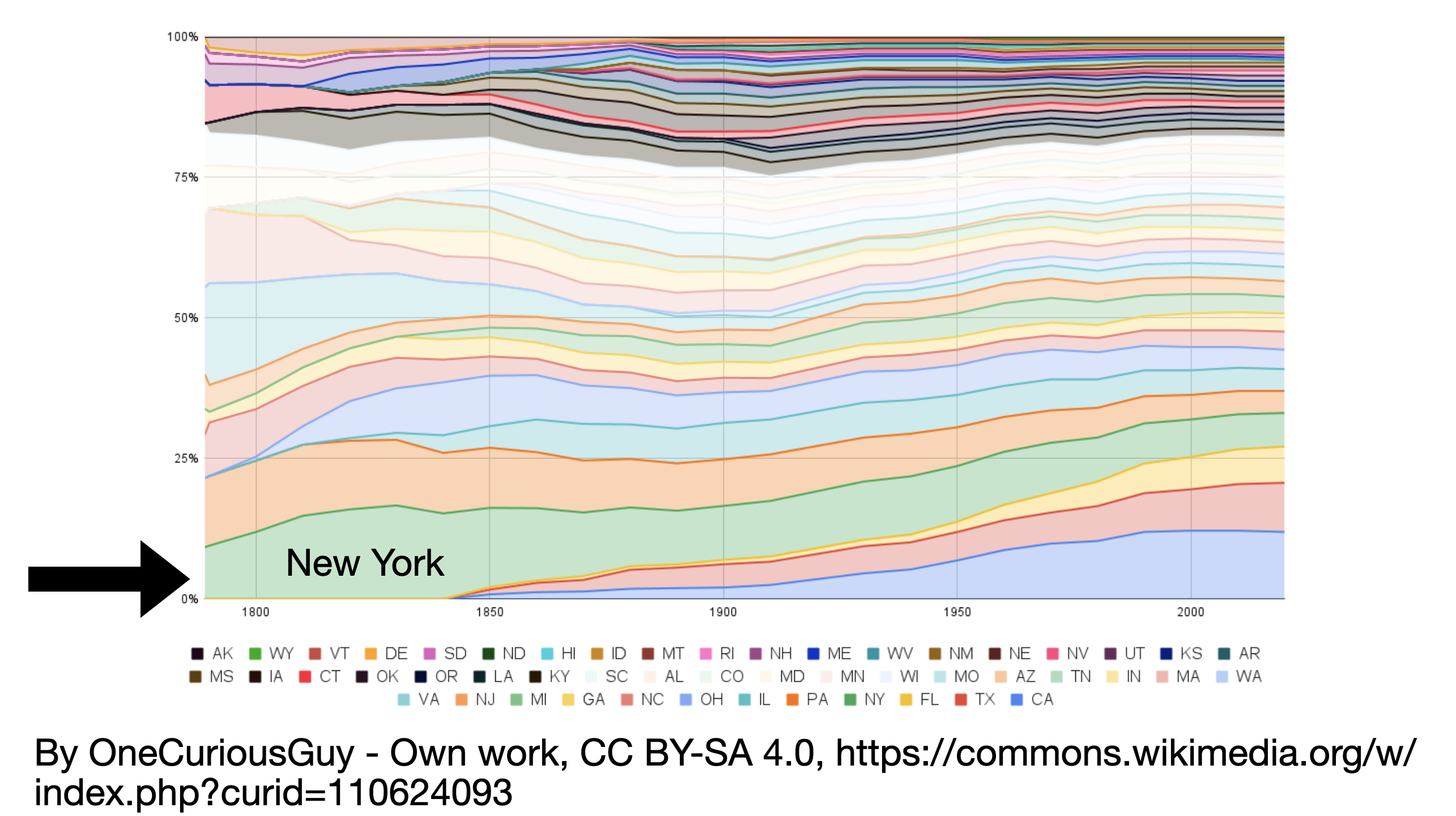
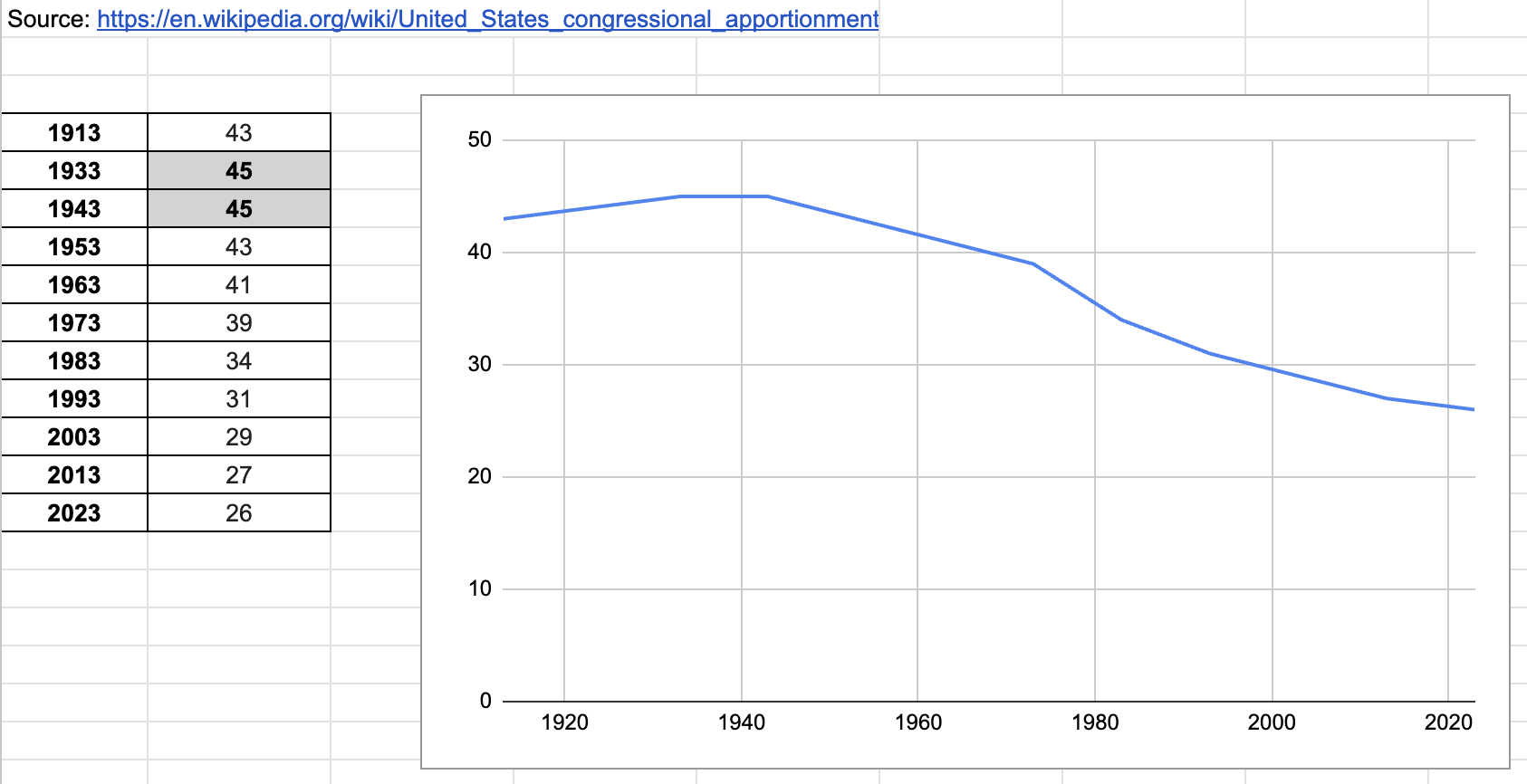
<p>Since the early 20th century, New York’s share of the national population has declined relative to other states. This shift is reflected in the state’s representation in the U.S. House of Representatives, which has steadily decreased as population growth has moved elsewhere (see Figures 1 and 2). While many factors contribute to this trend, governance quality and cost of living influence whether people choose to stay, invest, and raise families.</p>

<p><img src="/blog/assets/images/ny-house-share-over-time.png" alt="Figure 1. New York's share of U.S. House representation over time." /></p>

<p><em>Figure 1. New York’s share of seats in the U.S. House of Representatives relative to other states, illustrating a long-term decline in national representation.</em></p>

<p><img src="/blog/assets/images/ny-house-seats-over-time.png" alt="Figure 2. Number of U.S. House seats held by New York, 1913–2023." /></p>

<p><em>Figure 2. Absolute number of U.S. House seats held by New York since the House was standardized at 435 members.</em></p>

<p>This project is premised on a belief that decline is not inevitable.
Better information enables better choices—and better governance.</p>

<hr />

<h2 id="what-this-project-will-do">What This Project Will Do</h2>

<p>The New York Benchmarking Project aims to:</p>

<ol>
  <li><strong>Collect and document financial and governance data</strong> starting with the 62 cities in New York State and moving on to its counties, towns, villages, districts, and authorities.</li>
  <li><strong>Publish comparable metrics</strong> that allow meaningful benchmarking across jurisdictions.</li>
  <li><strong>Explain methods and assumptions transparently</strong>, so conclusions can be challenged and improved.</li>
  <li><strong>Support civic education</strong>, public discussion, and evidence-based reform.</li>
</ol>

<p>All work is intended to be transparent and verifiable.
All claims are intended to be traceable.</p>

<hr />

<h2 id="what-this-project-will-not-do">What This Project Will Not Do</h2>

<ul>
  <li>Advocate for a specific political party or ideology</li>
  <li>Replace democratic decision-making</li>
  <li>Reduce complex policy choices to a single metric</li>
</ul>

<p>Data informs judgment; it does not substitute for it.</p>

<hr />

<h2 id="where-this-is-going">Where This Is Going</h2>

<p>This site will publish:</p>
<ul>
  <li>Essays explaining the motivation and methodology</li>
  <li>Notes on data sources and limitations</li>
  <li>Early findings and comparisons as they emerge</li>
</ul>

<p>A <a href="https://benchmarkusa.org">public data explorer</a> is in development and will be made available as the dataset matures.</p>

<p>The work will be slow, careful, and incremental by design.</p>

<p>New York deserves government that works as well as its people do.
Benchmarking is one step toward that goal.</p>]]></content><author><name>Ben Unger</name></author><category term="project" /><category term="benchmarking" /><category term="civic-reform" /><category term="transparency" /><category term="osc" /><category term="municipal-finance" /><category term="new-york" /><summary type="html"><![CDATA[An introduction to the New York Benchmarking Project and the case for civic reform through systematic comparison of local government financial data.]]></summary><media:thumbnail xmlns:media="http://search.yahoo.com/mrss/" url="https://benchmarkusa.org/blog/assets/images/og-default.png" /><media:content medium="image" url="https://benchmarkusa.org/blog/assets/images/og-default.png" xmlns:media="http://search.yahoo.com/mrss/" /></entry></feed>